Choosing the best DeFi wallet in 2026 depends on how you actually use crypto. An EVM trader, a Solana user, a mobile-first investor, a hardware wallet holder, and a DAO treasury manager all need different tools.
This guide compares the best DeFi wallets by use case, security model, supported networks, hardware wallet support, recovery options, and real DeFi usability, so you can choose the wallet setup that fits your activity instead of chasing the longest token list.
Editor's Note (May 30, 3036): We fully updated this article in May 2026 to reflect the current DeFi wallet market, including new wallet picks, updated use cases, clearer security guidance, smart wallet and seedless recovery options and hardware wallet considerations.
Quick Answer: Best DeFi Wallets in 2026
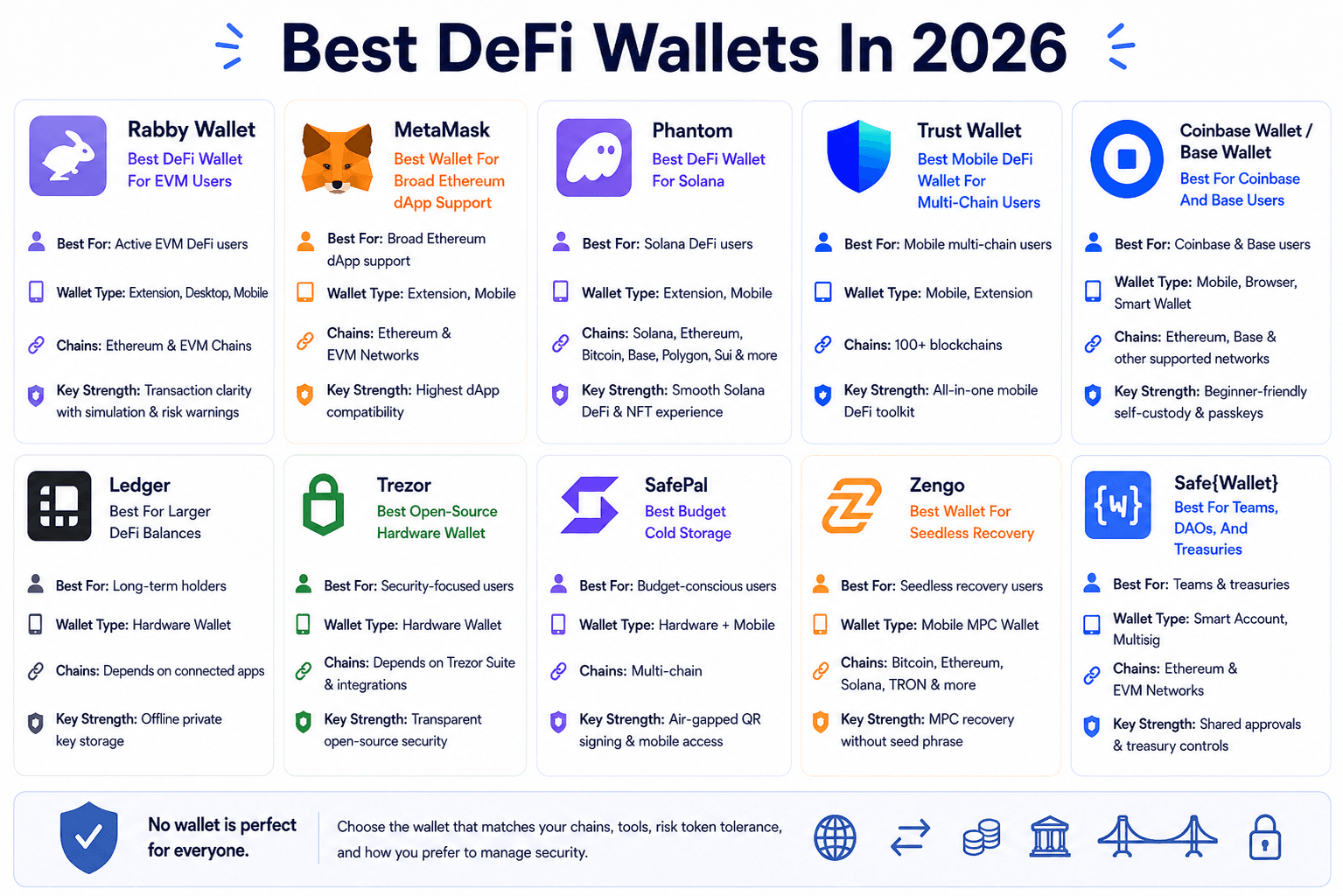
Rabby is best for active EVM DeFi, MetaMask is best for broad Ethereum DApp access, Phantom is best for Solana DeFi, Trust Wallet is best for mobile multi-chain users, Coinbase Wallet is best for Coinbase and Base users, Ledger and Trezor are better for larger balances, SafePal is best for budget cold storage, Zengo is best for seedless recovery, and Safe{Wallet} is best for teams and treasuries.
Rabby Wallet
Best for Ethereum, Base, Arbitrum, Optimism, Polygon, BNB Chain and other EVM users who want transaction simulation, balance-change previews and clearer risk warnings.
MetaMask
A strong default for users who want broad Ethereum and EVM DApp compatibility across DeFi apps, NFT marketplaces, DAOs and token tools.
Phantom
Best for Solana users who want smooth access to swaps, staking, NFTs, Jupiter, Kamino, Orca, Raydium and other Solana-native DApps.
Trust Wallet
A practical mobile-first wallet for users who want one app for many chains, swaps, staking, NFTs, DApp access and broad token storage.
Coinbase Wallet / Base Wallet
Best for users who already use Coinbase or want easier access to Base DeFi through a beginner-friendly wallet and passkey-based smart wallet flows.
Ledger
Best for larger DeFi balances when paired with Rabby or MetaMask, since private keys stay offline while the software wallet handles the DApp interface.
Trezor
A strong cold-storage option for users who value open-source design, seed control and offline signing more than the fastest DeFi workflow.
SafePal
Best for users who want affordable hardware-wallet protection, air-gapped QR signing and mobile access to swaps, staking and DApps.
Zengo
Best for beginners who want self-custody without managing a traditional seed phrase, using MPC-based recovery instead.
Safe{Wallet}
Best for shared funds because teams can set signer roles and approval thresholds before treasury transactions move.
Disclaimer
This guide is for educational purposes only and is not financial advice. Always verify wallet URLs, device authenticity, supported networks, recovery flows, approvals and transaction details before connecting to any DeFi app.
Disclosure
Some links in this guide may be affiliate links. If you choose to use a service through these links, we may earn a commission at no additional cost to you.
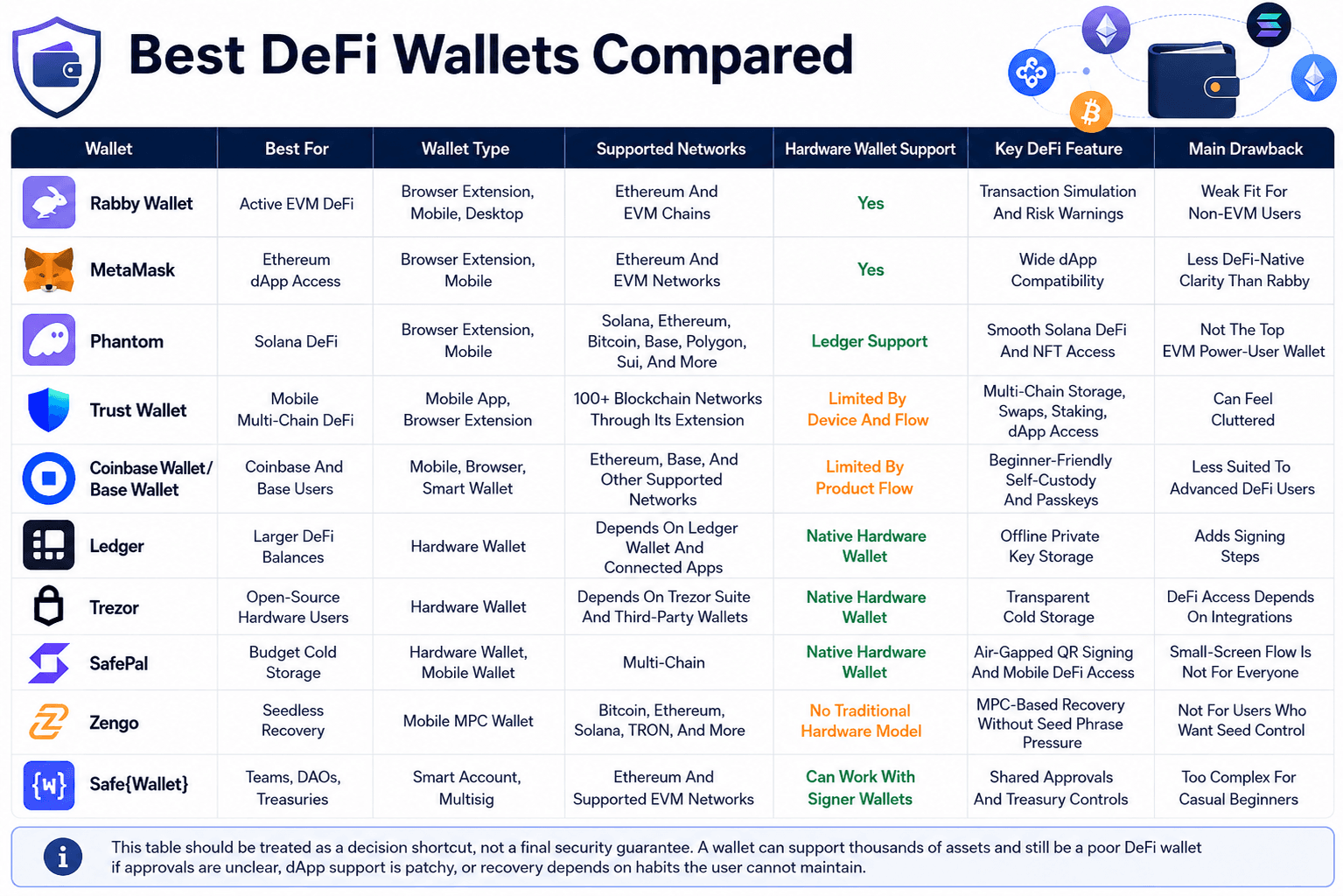
Best DeFi Wallets At A Glance
| Wallet | Best For | Wallet Type | Supported Networks | Hardware Wallet Support | Key DeFi Feature | Main Drawback |
|---|---|---|---|---|---|---|
| Rabby Wallet | Active EVM DeFi | Browser Extension, Mobile, Desktop | Ethereum And EVM Chains | Yes | Transaction Simulation And Risk Warnings | Weak Fit For Non-EVM Users |
| MetaMask | Ethereum DApp Access | Browser Extension, Mobile | Ethereum And EVM Networks | Yes | Wide DApp Compatibility | Less DeFi-Native Clarity Than Rabby |
| Phantom | Solana DeFi | Browser Extension, Mobile | Solana, Ethereum, Bitcoin, Base, Polygon, Sui, And More | Ledger Support | Smooth Solana DeFi And NFT Access | Not The Top EVM Power-User Wallet |
| Trust Wallet | Mobile Multi-Chain DeFi | Mobile App, Browser Extension | 100+ Blockchain Networks Through Its Extension | Limited By Device And Flow | Multi-Chain Storage, Swaps, Staking, DApp Access | Can Feel Cluttered |
| Coinbase Wallet / Base Wallet | Coinbase And Base Users | Mobile, Browser, Smart Wallet | Ethereum, Base, And Other Supported Networks | Limited By Product Flow | Beginner-Friendly Self-Custody And Passkeys | Less Suited To Advanced DeFi Users |
| Ledger | Larger DeFi Balances | Hardware Wallet | Depends On Ledger Wallet And Connected Apps | Native Hardware Wallet | Offline Private Key Storage | Adds Signing Steps |
| Trezor | Open-Source Hardware Users | Hardware Wallet | Depends On Trezor Suite And Third-Party Wallets | Native Hardware Wallet | Transparent Cold Storage | DeFi Access Depends On Integrations |
| SafePal | Budget Cold Storage | Hardware Wallet, Mobile Wallet | Multi-Chain | Native Hardware Wallet | Air-Gapped QR Signing And Mobile DeFi Access | Small-Screen Flow Is Not For Everyone |
| Zengo | Seedless Recovery | Mobile MPC Wallet | Bitcoin, Ethereum, Solana, TRON, And More | No Traditional Hardware Model | MPC-Based Recovery Without Seed Phrase Pressure | Not For Users Who Want Seed Control |
| Safe{Wallet} | Teams, DAOs, Treasuries | Smart Account, Multisig | Ethereum And Supported EVM Networks | Can Work With Signer Wallets | Shared Approvals And Treasury Controls | Too Complex For Casual Beginners |
 10 Wallets Compared By Use Case And Security
How We Chose The Best DeFi Wallets (Methodology)
The best DeFi wallet is not always the one with the most tokens. It is the one that makes DeFi easier, safer and clearer to use.
- We prioritized wallets that connect smoothly to DApps and support the chains people actually use.
- We looked at whether each wallet gives users control over private keys, seed phrases or recovery.
- We considered transaction previews, risk warnings and approval controls, since many DeFi mistakes happen before funds move.
- We favored wallets with strong mobile or browser usability, hardware wallet support and clear recovery options.
- We also checked staking access, swap access, lending compatibility, security history and WalletConnect support.
In simple terms, we focused on real DeFi use over token count.
Best DeFi Wallets In 2026
The best DeFi wallets in 2026 serve different jobs, so the right pick depends on whether you use EVM chains, Solana, mobile DeFi, hardware storage, seedless recovery, or shared treasury management.
1
Rabby Wallet: Best DeFi Wallet For EVM Users
Wallet type: Browser extension, desktop wallet, and mobile wallet
⌄
Rabby Wallet: Best DeFi Wallet For EVM Users
Rabby Wallet is built for Ethereum and EVM-compatible chains, which makes it one of the strongest picks for users who move across Layer 2s, DEXs, lending markets, bridges, and yield apps. It feels less like a generic crypto wallet and more like a DeFi control panel for active EVM users.
2
MetaMask: Best Wallet For Broad Ethereum DApp Support
Wallet type: Browser extension and mobile app
⌄
MetaMask: Best Wallet For Broad Ethereum DApp Support
MetaMask remains one of the most widely supported Ethereum wallets because many DApps still treat it as the default Web3 connection option. It is not always the cleanest wallet for active DeFi risk review, but its reach across Ethereum apps is still hard to ignore.
3
Phantom: Best DeFi Wallet For Solana
Wallet type: Browser extension and mobile wallet
⌄
Phantom: Best DeFi Wallet For Solana
Phantom is the clearest pick for Solana DeFi because its product experience, app support, and user base are still closely tied to the Solana ecosystem. It has expanded into other networks, but its best use case remains Solana swaps, staking, NFTs, and DApps.
4
Trust Wallet: Best Mobile DeFi Wallet For Multi-Chain Users
Wallet type: Mobile wallet and browser extension
⌄
Trust Wallet: Best Mobile DeFi Wallet For Multi-Chain Users
Trust Wallet is best for users who want mobile-first access to many chains, tokens, swaps, staking options, NFTs, and DApps from one app. It is not the sharpest specialist wallet, but it is one of the better choices for broad mobile crypto use.
5
Coinbase Wallet/Base Wallet: Best DeFi Wallet For Coinbase And Base Users
Wallet type: Mobile wallet, browser wallet, and smart wallet
⌄
Coinbase Wallet/Base Wallet: Best DeFi Wallet For Coinbase And Base Users
Coinbase Wallet and Base Wallet are strong beginner-friendly options for users who already trust Coinbase or want easier access to Base DeFi. The bigger shift is the Coinbase Smart Wallet, which uses passkeys and smart wallet flows instead of forcing every user into seed-phrase-first onboarding.
6
Ledger: Best Hardware Wallet For DeFi
Wallet type: Hardware wallet
⌄
Ledger: Best Hardware Wallet For DeFi
Ledger is the strongest mainstream hardware wallet pick for DeFi users who want offline private key storage. It works best when paired with a software wallet such as MetaMask or Rabby, where Ledger handles signing, and the software wallet handles the DeFi interface.
7
Trezor: Best Open-Source Hardware Wallet For DeFi
Wallet type: Hardware wallet
⌄
Trezor: Best Open-Source Hardware Wallet For DeFi
Trezor is the best open-source hardware wallet pick for users who value transparent cold storage and direct private key control. It is better understood as a secure signing device than as a DeFi-first wallet.
8
SafePal: Best Budget Hardware Wallet For DeFi Access
Wallet type: Hardware wallet, mobile wallet, and browser extension
⌄
SafePal: Best Budget Hardware Wallet For DeFi Access
SafePal is the best budget hardware wallet pick for users who want cold-storage-style protection with mobile DeFi access. It stands out because the SafePal S1 uses air-gapped QR-code signing rather than a typical always-connected flow.
9
Zengo: Best Seedless DeFi Wallet For Beginners
Wallet type: Mobile MPC wallet
⌄
Zengo: Best Seedless DeFi Wallet For Beginners
Zengo is the best seedless wallet for beginners who want self-custody without managing a traditional recovery phrase. Its MPC-based model replaces the usual seed phrase setup with key-share recovery.
10
Safe{Wallet}: Best DeFi Wallet For Teams, DAOs, and Multisig
Wallet type: Smart account and multisig wallet
⌄
Safe{Wallet}: Best DeFi Wallet For Teams, DAOs, and Multisig
Safe{Wallet} is the strongest wallet for teams, DAOs, protocols, investment groups, and shared treasuries because it uses smart accounts and multisig approvals. It is built for shared control, not casual solo trading.
 The Strongest Wallets For DeFi Users Today
Best DeFi Wallets By Use Case
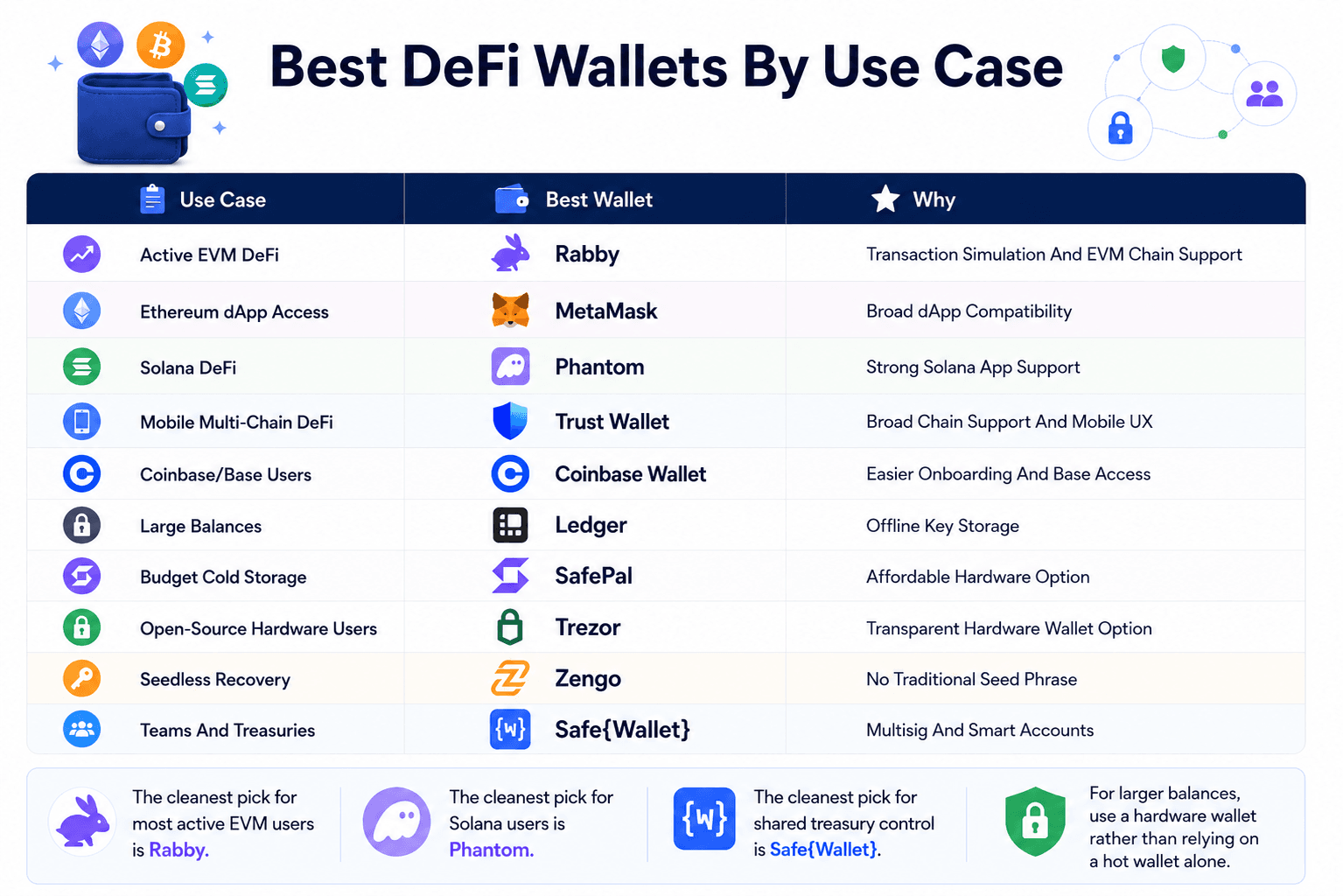 Wallet Picks Matched To Specific DeFi Needs
The best DeFi wallet depends on the job: active EVM trading, Solana DeFi, mobile storage, hardware protection, seedless recovery, or team approvals.
| Use Case | Best Wallet | Why |
|---|---|---|
| Active EVM DeFi | Rabby | Transaction Simulation And EVM Chain Support |
| Ethereum dApp Access | MetaMask | Broad dApp Compatibility |
| Solana DeFi | Phantom | Strong Solana App Support |
| Mobile Multi-Chain DeFi | Trust Wallet | Broad Chain Support And Mobile UX |
| Coinbase/Base Users | Coinbase Wallet | Easier Onboarding And Base Access |
| Large Balances | Ledger | Offline Key Storage |
| Budget Cold Storage | SafePal | Affordable Hardware Option |
| Open-Source Hardware Users | Trezor | Transparent Hardware Wallet Option |
| Seedless Recovery | Zengo | No Traditional Seed Phrase |
| Teams And Treasuries | Safe{Wallet} | Multisig And Smart Accounts |
The cleanest pick for most active EVM users is Rabby. The cleanest pick for Solana users is Phantom. The cleanest pick for shared treasury control is Safe Wallet. For larger balances, use a hardware wallet rather than relying on a hot wallet alone.
What Is A DeFi Wallet?
A DeFi wallet is a non-custodial crypto wallet that lets users store assets and connect directly to decentralized applications. It gives the user control over access to funds through a private key, seed phrase, passkey, MPC system, or smart account setup.
That makes it different from a crypto exchange wallet. On an exchange, the company usually controls the custody layer and gives the user account access. With a non-custodial DeFi wallet, the user signs transactions directly. That creates more freedom, but it also puts security responsibility on the user.
DeFi wallets are used for swaps, staking, lending, borrowing, liquidity pools, NFTs, governance, bridges, and on-chain identity. The wallet acts as the signing layer between the user and the blockchain.
Crypto wallets can be divided into categories, some of which are:
| Wallet Type | How It Works | Best For | Main Trade-Off |
|---|---|---|---|
| Custodial Exchange Wallet | Exchange Controls Custody | Simple Buying And Selling | Less Direct Control |
| Non-Custodial DeFi Wallet | User Controls Keys Or Recovery | DApps, Swaps, Staking, Lending | User Handles Security |
| Hardware Wallet | Private Keys Stay Offline | Larger Balances, Long-Term Holding | Slower DeFi Flow |
| Smart Wallet | Uses Smart Account Features | Passkeys, Multisig, Recovery Controls | Depends On Chain And App Support |
A DeFi wallet can be simple or advanced depending on the recovery model. Traditional wallets use seed phrases. Smart wallets may use passkeys, account abstraction, or multisig rules, and MPC wallets split signing control across separate key shares, so users do not manage a standard seed phrase.
Also Read
- Best Crypto Wallets
- Best Crypto Wallets For Experienced Traders
- Most Secure Crypto Wallets
- Best Beginner-Friendly Wallets You Should Try
- Top Android Crypto Wallets
- Top Self-Custody Wallets
- Top Seedless Wallets
- Top Anonymous Crypto Wallets
- Best Hardware Wallets
Hot Wallet, Cold Wallet, or Smart Wallet: Which Should You Use For DeFi?
Most DeFi users should understand wallet categories before choosing a brand. Hot wallets, cold wallets, and smart wallets solve different problems, and each one fits a different level of activity, balance size, and security needs.
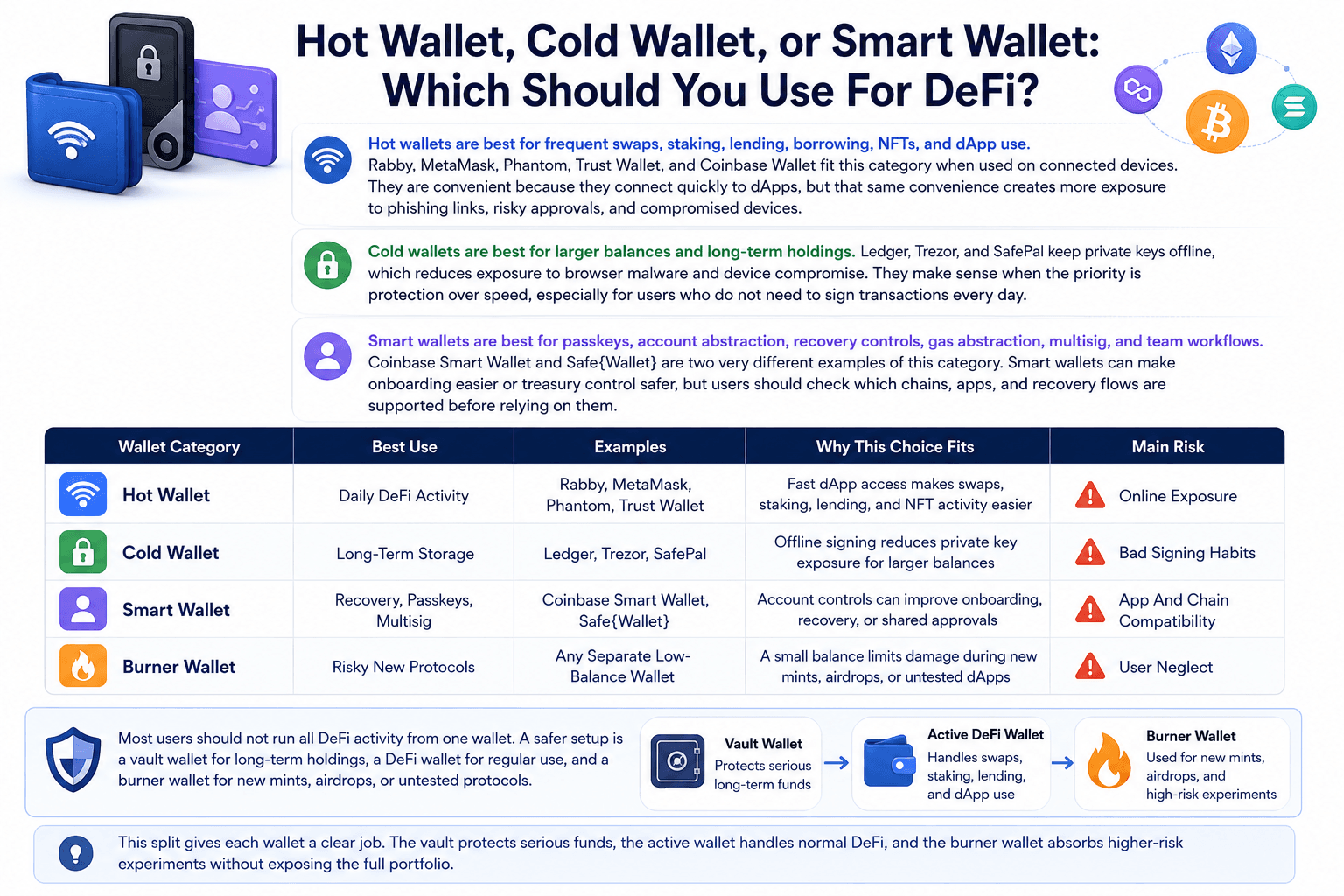 Different Wallet Types Serve Different Security Needs
Hot wallets are best for frequent swaps, staking, lending, borrowing, NFTs, and DApp use. Rabby, MetaMask, Phantom, Trust Wallet, and Coinbase Wallet fit this category when used on connected devices. They are convenient because they connect quickly to DApps, but that same convenience creates more exposure to phishing links, risky approvals, and compromised devices.
For a closer look at safe, easy-to-use software wallets, read our full guide to the best hot wallets.
Cold wallets are best for larger balances and long-term holdings. Ledger, Trezor, and SafePal keep private keys offline, which reduces exposure to browser malware and device compromise. They make sense when the priority is protection over speed, especially for users who do not need to sign transactions every day.
For stronger offline protection, read our full guide to the best cold storage wallets.
Smart wallets are best for passkeys, account abstraction, recovery controls, gas abstraction, multisig, and team workflows. Coinbase Smart Wallet and Safe Wallet are two very different examples of this category. Smart wallets can make onboarding easier or treasury control safer, but users should check which chains, apps, and recovery flows are supported before relying on them.
| Wallet Category | Best Use | Examples | Why This Choice Fits | Main Risk |
|---|---|---|---|---|
| Hot Wallet | Daily DeFi Activity | Rabby, MetaMask, Phantom, Trust Wallet | Fast dApp access makes swaps, staking, lending, and NFT activity easier | Online Exposure |
| Cold Wallet | Long-Term Storage | Ledger, Trezor, SafePal | Offline signing reduces private key exposure for larger balances | Bad Signing Habits |
| Smart Wallet | Recovery, Passkeys, Multisig | Coinbase Smart Wallet, Safe{Wallet} | Account controls can improve onboarding, recovery, or shared approvals | App And Chain Compatibility |
| Burner Wallet | Risky New Protocols | Any Separate Low-Balance Wallet | A small balance limits damage during new mints, airdrops, or untested dApps | User Neglect |
Most users should not run all DeFi activity from one wallet. A safer setup is a vault wallet for long-term holdings, a DeFi wallet for regular use, and a burner wallet for new mints, airdrops, or untested protocols.
This split gives each wallet a clear job. The vault protects serious funds, the active wallet handles normal DeFi, and the burner wallet absorbs higher-risk experiments without exposing the full portfolio.
The Safest DeFi Wallet Setup
The safest DeFi wallet setup usually uses more than one wallet. Separating long-term assets from daily activity limits damage if one wallet signs a bad approval, connects to a fake DApp, or gets exposed through a compromised device.
A single-wallet setup is convenient, but it creates one large failure point. If that wallet connects to a malicious site, approves an unsafe contract, or exposes a recovery phrase, the entire portfolio can be at risk. A layered setup gives users room for mistakes without turning every mistake into a full loss event.
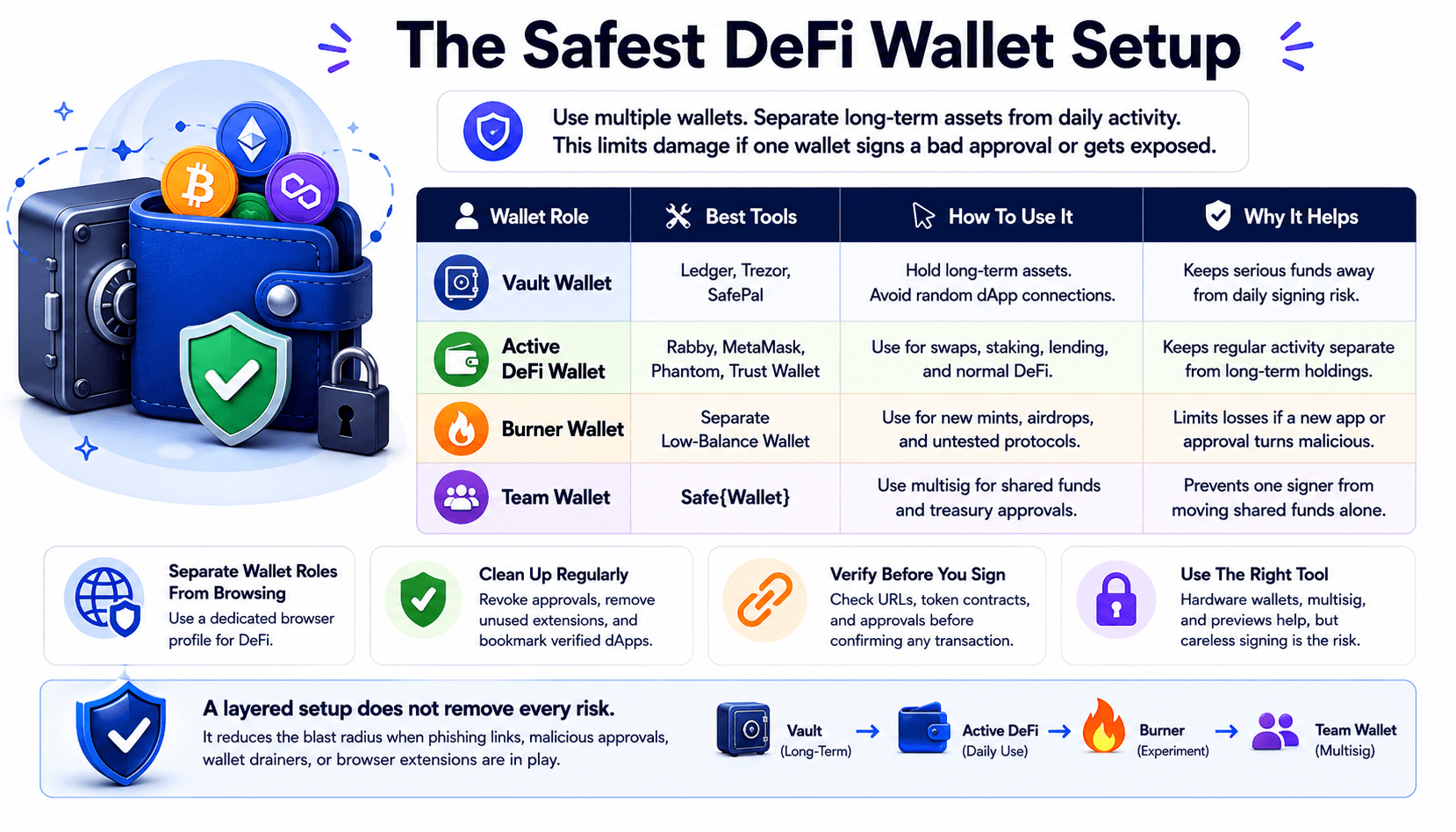 A Practical Setup For Safer DeFi Activity
| Wallet Role | Best Tools | How To Use It | Why It Helps |
|---|---|---|---|
| Vault Wallet | Ledger, Trezor, SafePal | Hold Long-Term Assets, Avoid Random DApp Connections | Keeps serious funds away from daily signing risk |
| Active DeFi Wallet | Rabby, MetaMask, Phantom, Trust Wallet | Use For Swaps, Staking, Lending, And Normal DeFi | Keeps regular activity separate from long-term holdings |
| Burner Wallet | Separate Low-Balance Wallet | Use For New Mints, Airdrops, And Untested Protocols | Limits losses if a new app or approval turns malicious |
| Team Wallet | Safe{Wallet} | Use Multisig For Shared Funds And Treasury Approvals | Prevents one signer from moving shared funds alone |
The vault wallet should be boring by design. It should hold long-term assets, avoid random DApp connections, and sign only when funds need to move between trusted wallets or established protocols. Hardware wallets such as Ledger, Trezor, and SafePal fit this role because private keys stay offline.
The active DeFi wallet should hold only the funds needed for regular activity. This is where Rabby, MetaMask, Phantom, or Trust Wallet makes sense. Use it for swaps, staking, lending, LP positions, and routine DApp interactions, but avoid treating it as the place where all assets live.
The burner wallet should carry a small balance and be treated as disposable. Use it for new mints, airdrops, test protocols, unfamiliar bridges, experimental games, or any app that has not earned trust yet. If something goes wrong, the loss should stay limited.
For teams, Safe{Wallet} is the cleaner setup because it avoids single-signer control. Shared approvals are slower, but they reduce the chance that one compromised device drains an entire treasury. A small team can set approval thresholds, such as two out of three signers or three out of five signers, depending on how much control they want to distribute.
Users should also separate wallet roles from browser habits. Do not use the same browser profile for casual browsing, Telegram links, unknown airdrops, and serious DeFi signing. A dedicated browser profile for DeFi can reduce accidental exposure to suspicious extensions and fake sites.
A strong setup also needs regular cleanup. Revoke old token approvals, remove unused browser extensions, bookmark verified DApps, check URLs before signing, and avoid entering seed phrases into any website. Hardware wallets, multisig, and transaction previews help, but they cannot fix careless signing.
Key Features To Look For In A DeFi Wallet
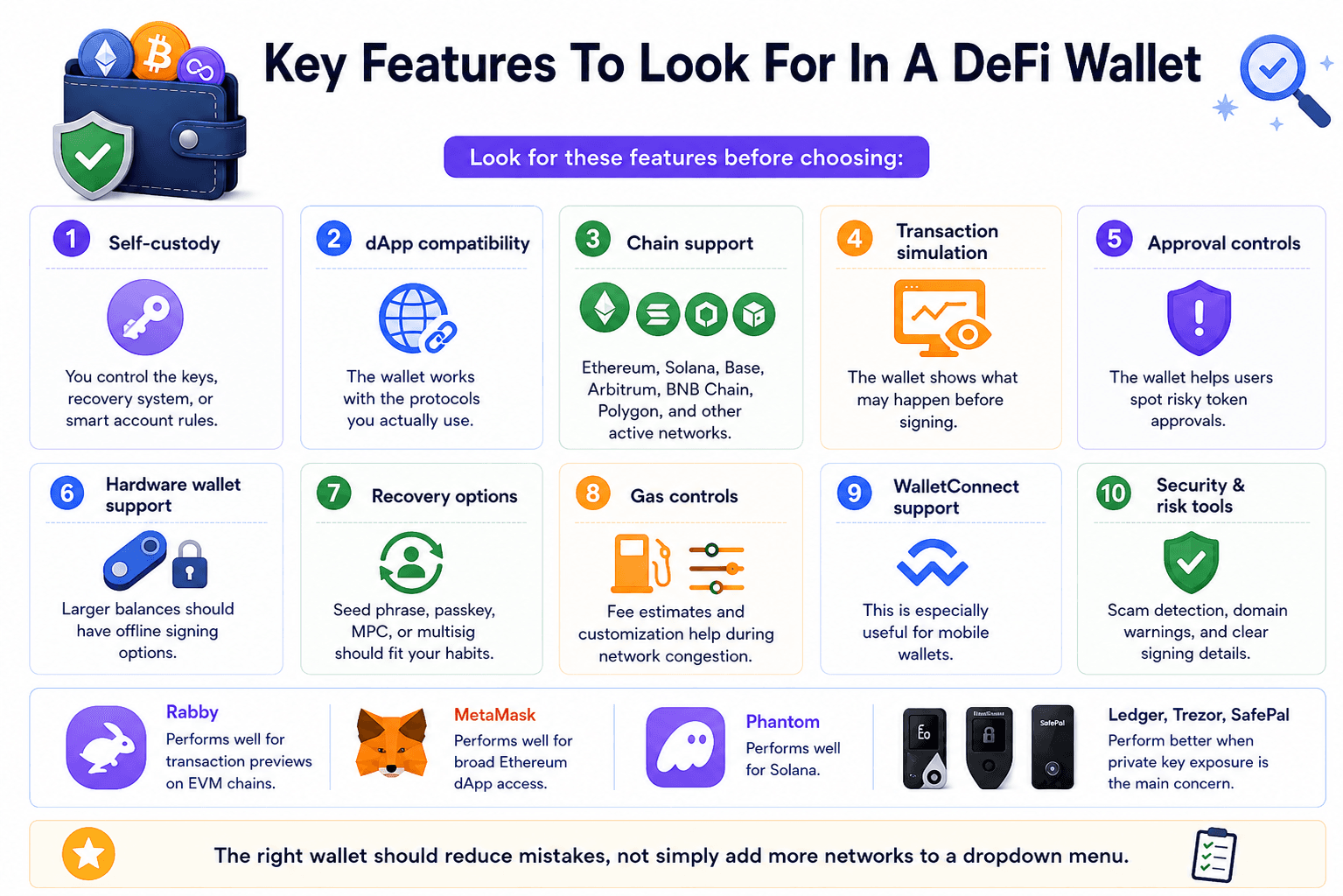 Wallet Features That Define The Real DeFi Safety
A good DeFi wallet should make signing, recovery, DApp access, and risk review easier. Token support is useful, but it should not be the only selection filter.
Look for these features before choosing:
- Self-custody: You control the keys, recovery system, or smart account rules.
- DApp compatibility: The wallet works with the protocols you actually use.
- Chain support: Ethereum, Solana, Base, Arbitrum, BNB Chain, Polygon, and other active networks.
- Transaction simulation: The wallet shows what may happen before signing.
- Approval controls: The wallet helps users spot risky token approvals.
- Hardware wallet support: Larger balances should have offline signing options.
- Recovery options: Seed phrase, passkey, MPC, or multisig should fit your habits.
- Gas controls: Fee estimates and customization help during network congestion.
- WalletConnect support: This is especially useful for mobile wallets.
The right wallet should reduce mistakes, not simply add more networks to a dropdown menu.
DeFi Wallet Risks You Need To Know Before Connecting
DeFi wallet risk usually comes from what users sign, where they connect, and how they store recovery details. A wallet can be well-built and still lose funds if the user approves a malicious transaction.
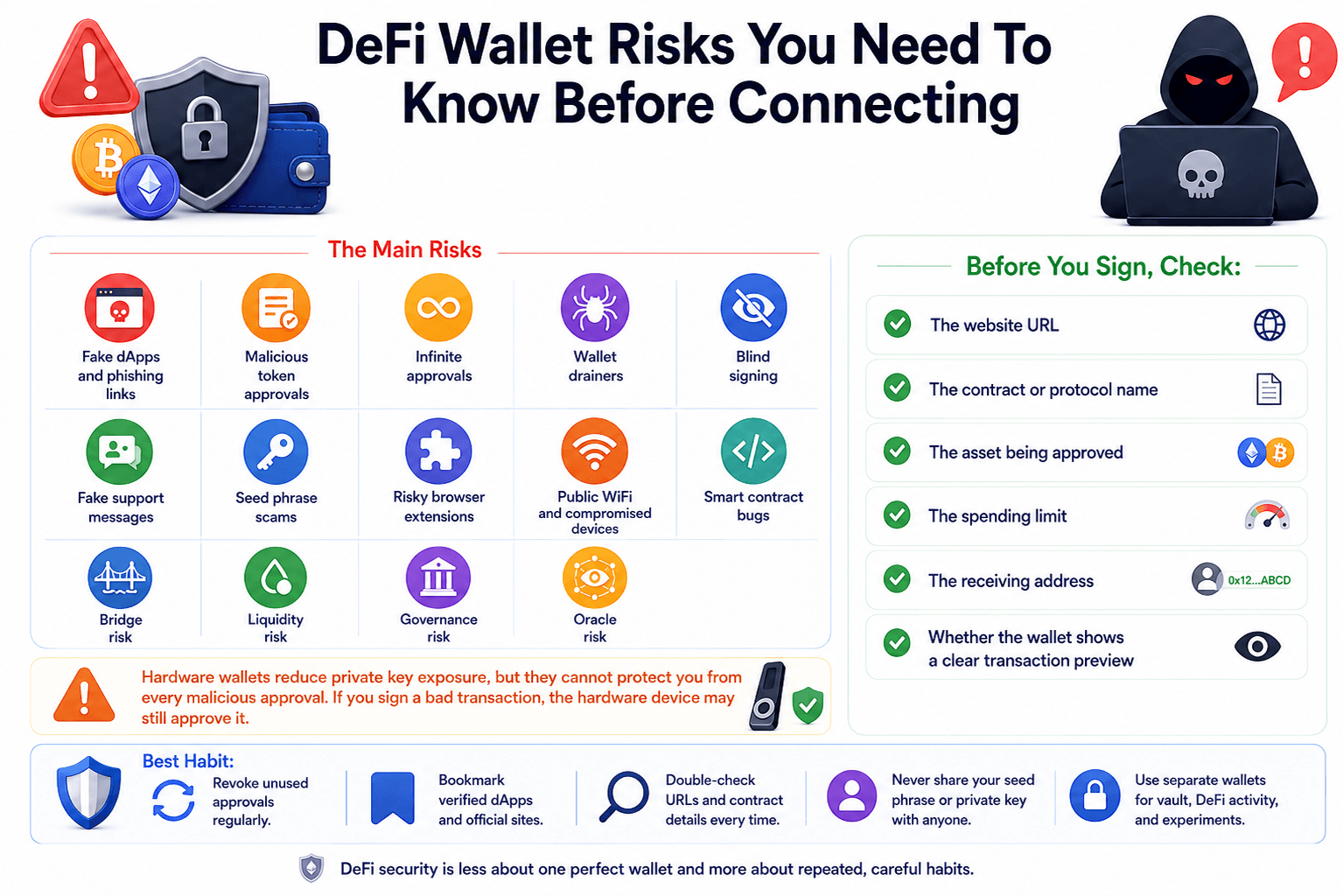 Common Wallet Risks Every DeFi User Faces
The main risks include:
- Fake DApps and phishing links
- Malicious token approvals
- Infinite approvals
- Wallet drainers
- Blind signing
- Fake support messages
- Seed phrase scams
- Risky browser extensions
- Public WiFi and compromised devices
- Smart contract bugs
- Bridge risk
- Liquidity risk
- Governance risk
- Oracle risk
Hardware wallets reduce private key exposure, but they cannot protect users from every malicious approval. If a user signs a bad transaction, the hardware device may still approve it. That is why clear signing, transaction previews, and careful review are so useful.
Before signing, check:
- The website URL
- The contract or protocol name
- The asset being approved
- The spending limit
- The receiving address
- Whether the wallet shows a clear transaction preview
Users should also revoke unused approvals from time to time, especially after interacting with unfamiliar protocols. DeFi security is less about one perfect wallet and more about repeated, careful habits.
How To Choose The Best DeFi Wallet For You
The best DeFi wallet for you depends on your chain, skill level, and risk tolerance. Choose based on actual use, not the longest list of supported tokens.
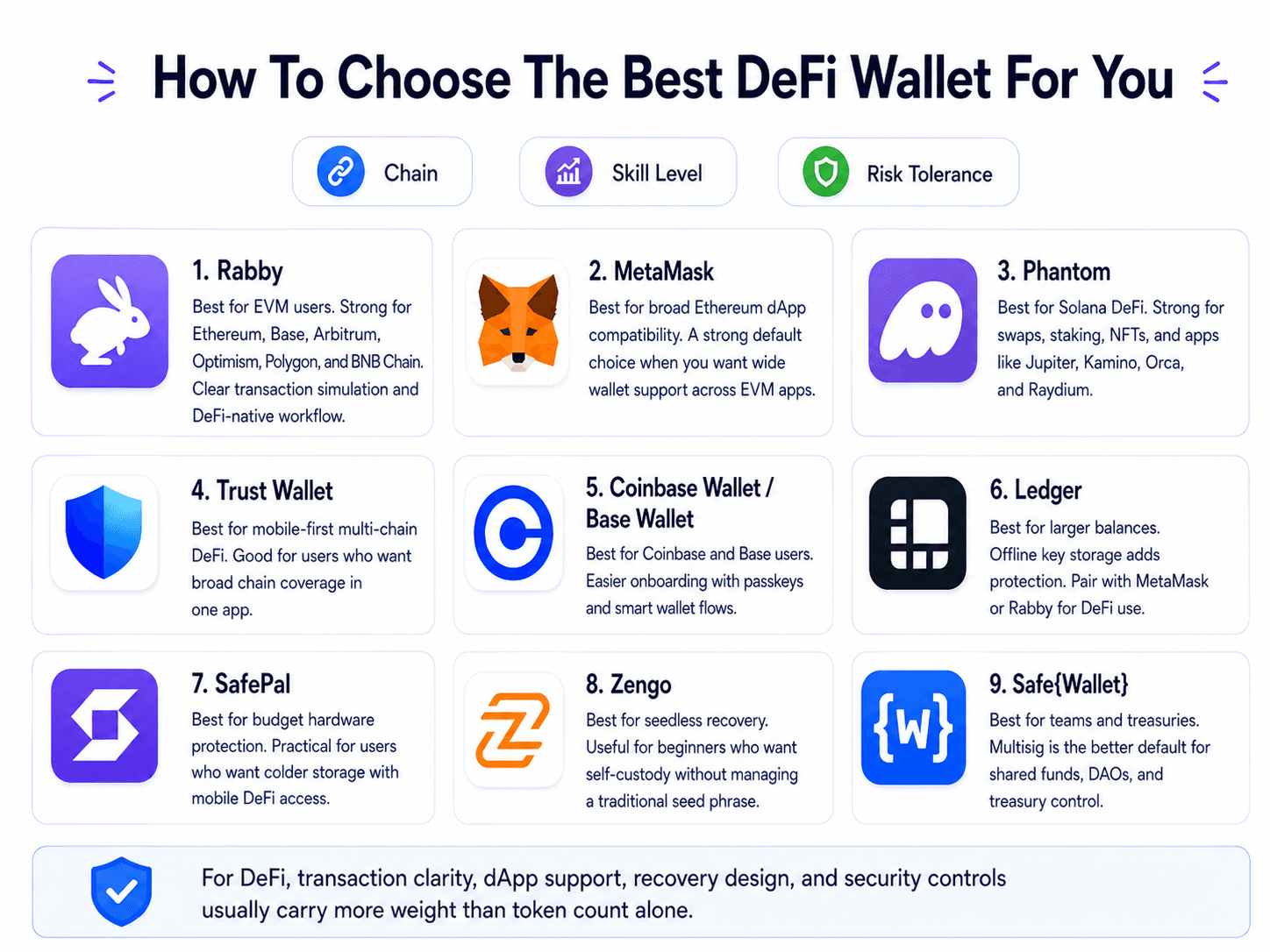 Pick A Wallet Based On Actual Usage
- Choose Rabby if you mostly use Ethereum, Base, Arbitrum, Optimism, Polygon, BNB Chain, or other EVM chains. Its transaction simulation and DeFi-native workflow make it the strongest active EVM pick.
- Choose MetaMask if you want the most widely supported Ethereum wallet. It remains one of the safest default choices for broad dApp compatibility.
- Choose Phantom if you mainly use Solana DeFi. It has strong support across Solana swaps, staking, NFTs, and major apps like Jupiter, Kamino, Orca, and Raydium.
- Choose Trust Wallet if you want mobile-first multi-chain DeFi. It is best for users who want broad chain coverage in one app.
- Choose Coinbase Wallet or Base Wallet if you already use Coinbase or want easier Base onboarding. The passkey and smart wallet approach can feel less intimidating for beginners.
- Choose Ledger if you hold larger balances and want offline key storage. Pair it with MetaMask or Rabby if you also use DeFi.
- Choose SafePal if you want budget hardware wallet protection with mobile DeFi access. It is practical for users who want cold storage without spending more.
- Choose Zengo if you want seedless recovery. It is useful for beginners who fear losing a traditional seed phrase.
- Choose Safe{Wallet} if you manage shared funds. Multisig is the better default for teams, DAOs, and treasuries.
Do not choose based only on the number of supported tokens. For DeFi, transaction clarity, dApp support, recovery design, and security controls often carry more weight.

Closing Thoughts: Which DeFi Wallet Should You Use?
Rabby is the strongest pick for active EVM DeFi users in 2026. Phantom is the clear pick for Solana DeFi. Trust Wallet and Coinbase Wallet are better for mobile-first or beginner users.
The safest choice is often not one wallet. It is a setup that separates long-term storage from daily DeFi activity. Use a vault wallet for serious holdings, an active wallet for regular DeFi, and a burner wallet for higher-risk interactions.